CHARACTER ANALYSIS – Writing In Role
By: Kylie Chiu
The different values and elements brought
out from characters is what will make a story interesting and appealing. The
characters have a great impact on the story and a deeper understanding of them,
will make the plot and story line become much more clearer. As I read my
required section (page 99-192) I was exposed to the different traits found
within each character. To me the three most influential characters include
Atticus Finch, the protagonist’s father, and Scout Finch, the protagonist
herself and Calpurnia, the housekeeper and nanny of the Finch’s residence.
ATTICUS FINCH
If I were to describe
myself in a split second, I would have to say I’m different. Different in
a sense, that regardless what others have to say about my opinions, I believe
in what I believe. The comments I hear from others, have no influence into
the decisions I make, my reasoning for that? Well, I feel as if my life is only
constructed by my opinions, other people have lives to build, destruct and
enjoy themselves, why intervene with mine? I remember when Scout was introduced
to Negroes. The kids in her school teased her because her father, myself, was
defending a black man. She was exposed to the word “nigger” in which made me
upset, I remember my exact words to her were “No matter what anybody says to
you, don’t you let ‘em get your goat.” (Lee 101) There was another discussion
I had with Scout along the same lines of believing in what I want to believe
in. The exact words I spoke were “They’re certainly entitled to think that, and
they’re entitled to full respect for their opinions, but before I can live with
other folks, I’ve got to live with myself. The one thing that doesn’t abide by
majority rule is a person’s conscience.” (Lee 139) Like I explained earlier,
people are entitled to their own opinions and beliefs and to me no one has the
right to alter your decisions because everyone has a different view. Aside from
my beliefs and values, I have to admit that I am an over
protective father. After losing my wife, raising children by myself has
always been a struggle. Not to long ago aunt Alexandra and I had a discussion
about letting Scout free. “Besides, I don’t think
the children’ve suffered one bit from having brought them up. If
anything, she’s been harder on them in some ways than a mother would have been
…” (Lee 183) I of course was talking about Calpurnia, although some may
say my parenting has been harsh, I would have to admit that Calpurnia’s
was much more worse. I said to aunt Alexandra “ I do understand
that at times, I can be harsh. But that’s because Scout is my little girl and
she means the world to me.” I did not want to bring up my wife but I guess I
had nothing better to say so I blurted out “ She is the only girl in my life,
after I lost Sandy (my wife) I felt as if I had to keep Scout close
and i'm not ready to lose her too.” Right off the bat, you can definitely
tell that I have “trust” issues but I guess that is something I will hold on to
till the day I am ready to let go of my little girl.

Jean Louise “Scout” Finch
Hey there! I’m Jean, most
people call me Scout but feel free to call me whatever. My life has been going
good, at the most part. To tell you that I’m happy would be a lie, but to tell
you my life’s miserable is also a lie. Let me tell you a story I remember from
when I was small and tell me if you can get a sense of how I felt. Aunt
Alexandra had come to visit my father and I and well I pretty much entered the
room in hopes of having a discussion with Atticus, my dad, but what I hoped for
turned out to be something I feared. “I’m sorry, Aunty” (Lee 181) were the
words that so hesitantly fell out of my mouth, but did the apology
have any meaning? Of course it didn’t. “I concluded that the only way I could
retired with a shred of dignity was to go to the bathroom, where I stayed long
enough to make them think I had to go” (Lee 182) what did I really do in
the bathroom? I cried and laughed but mostly spent my time crying and
asking myself what I did wrong to make Atticus so upset? Oh how I wished aunt
Alexandra did not come to visit, but I then in that instant I regretted
what I had said because I was raised to value the family around me because
having loved ones around you is always better than being alone. Enough of
that story, I have been told multiple times that I am quite the aggressive
child and that at times I can be a handful. Atticus always reminds me of the
story in which I fought with my nephew Francis. My dad told me that I
apparently ended up with a bloody knuckle, which now I look back to makes me
seem foolish. I don't remember the story completely but once Atticus told me
what had happened, my vision became clear and this is how I believe it
went "This time, I split my knuckle to the bone on his front teeth.
My left impaired, I sailed in with my right, but not for long." (Lee
112) I guess you can say that my interest as a young kid, involves tomboy
like activities. Like my father, the opinions of others didn’t really have an
impact on my life; I lived according to how I felt. Although aunt Alexandra was
always on my case about being a tomboy, it never really bothered me. I liked
playing sports, fighting and apparently to many it was not female like, but
hey, I had fun and that’s all that matters!

Calpurnia
Hello there! Before I tell you about the
crazy adventures and experience I was able to come across let me tell you a bit
of my background. I was never able to have kids of my own and I told myself
multiple times that kids would never exist in my life because the love I give
my own children can never come close to the love I give others. Scout and Jem
Finch on the other hand taught me that children, whether blood or not, can be
loved and cherished. They unfortunately lost their mother, and I was ready to
be one. Luckily, thanks to Atticus I was hired to be the housekeeper/nanny and
I could never have been any happier. But, there was this one-day out of the
many that I took them to church, had we ever come upon this situation. “I don’t
want anybody sayin’ I don’t look after my children” (Lee 157) These kids
mean the world to me and I value them greatly. But being a woman of color, I
feel sometimes the Americans too are disregarded and not fathomed. When Scout,
Jem and I were about to enter the church, Lula came up to me and said, “You
ain’t got no business brinin’ white chillum here-they got their church, we got
our’n. It is our church, ain’t it, Miss Cal?” (Lee 158) This made me
furious and so as I heard those words I gathered both my kids into my arms,
making them feel welcomed and loved. It is hard living in a community in which
people of colour are discriminated, but in some parts of the town, there are
situations in which vice versa occurs.
Other than my motherly side, I would have to say that everyday I strive
to do my best. My best to keep the people in the town safe and to ensure that
everyone is happy and safe with where they’re at in life. In detail, Atticus described to me the
incident in which I acted like a messenger when Tim Johnson had come to visit.
“We watched Calpurnia running toward the Radley Place, holding her skirt and
apron above her knees. She went up to the front steps and banged on the door…
Calpurnia pounded on the door in vain” (Lee 124) The way Atticus described
the event, made me seem like a mad man, but by now I hope you can tell that
when I believe in something, boy do I stick to my beliefs.

CONCLUSION
Atticus, Scout and Calpurnia to me were the
three most important characters that made a great impact in my section. The understandings
of characters are very important as it gives a clearer view of the story line
and plot. Characters also have a great impact on how interesting a story can be,
compared to a novel that may be boring and dull.
Today I realized that not everyone is good. And no one will ever think what I have to say is important because I am just a child who is not smart, strong, or powerful enough to make a big difference and make adults listen. “It’s like bein‘ a caterpillar in a cocoon, that’s what it is. Like somethin’ asleep wrapped up in a warm place. I always thought Maycomb folks were the best folks in the world, least that’s what they seemed like.” (Lee 219) But watch. I’m growing hairs on my chest, and will be on the football team next year. I will prove that I am strong, and bring justice to this town!
“If there’s just one kind of folks, why can’t they get along with each other? If they’re all alike, why do they go out of their way to despise each other? I think I’m beginning to understand something. I think I’m beginning to understand why Boo Radley’s stayed shut up in the house all this time… it’s because he wants to stay inside.” (231) People in the world are vicious and only seem to care about themselves. I wish things were more simpler…
Atticus Finch:
“There’s nothing more sickening to me than a low grade white man who’ll take advantage of a Negro’s ignorance.” (Lee 224) “As you grow older, you’ll see white men cheat black men every day of your life, but let me tell you something and don’t you forget it— whenever a white man does that to a black man, no matter who he is, how rich he is, or how fine a family he comes from, that white man is trash.” (Lee 224) That’s just a fact of life, and I’ve lived long enough to confirm that. We are all different, but we also share common qualities that make us all human. That’s why you should always look at things from another person’s perspective before you judge them. We all hold some kind of baggage, and it’s up to us to empathize, and be compassionate and accepting towards others. This is the only way people will feel respected and equal. And only then, justice can be served the right way. But until then, “we’ve made it this way for [our children], they might as well learn to cope with it.” (Lee 216) I try my best to enforce these morals onto my children because they are all I’ve got, and they are the future that can bring awareness and maybe even change the racism in Maycomb or even the world. I believe in them.
Aunt Alexandra:
Jean Louise just doesn’t understand that people like the Cunningham’s are not a good influence one her. I mean it’s already tough teaching her how to be lady-like no matter how many dresses I force her to wear. Now “there is no doubt in my mind that they’re good folks. But they’re not our kind of folks.” (Lee 227) “The thing is, you can scrub Walter Cunningham till he shines, you can put him in shoes and a new suit, but he’ll never be like Jem. Besides, there’s a drinking streak in that family a mile wide. Finch women aren’t interested in that sort of people.” (Lee 227) “I’ll tell you why. Because— he—is—trash, that’s why [she] can’t play with him. I’ll not have [her] around him, picking up his habits and learning Lord-knows-what. (Lee 228)
We… I mean… she could do so much better than that. I will not have her ruining her life and the family name by associating herself with low class people like the Cunningham’s. It would take much more effort undoing the damage they could make on her. I’ve already been trying so hard to help her build a proper lady-like character. Not to mention my brother’s decision to take the side of a black man in a trial. People have already been talking. Oh dear… I have to rebuild our respectable reputation.
Tiffany Kuo - Writing in Role
When reading the book I would have to say that their are 3 characters that stand out the most with me Jim, Scout, and Atticus. These characters play an important part in the beginning of the book because they set scene for what's going to happen later on in the book
Writing
in Role – Giselle Credo
Jeremy Atticus “Jem” Finch:
I can’t believe Tom Robinson was proven guilty! Bob Ewell is a liar and it’s not fair! How could the jury decide to kill a man for something he did not do? Even if he did do it, he didn’t hurt nobody. “Doesn’t make it right. You just can’t convict a man on evidence like that—you can’t.” (Lee 224) Atticus always told me to never judge anyone and to put myself in their shoes. But it’s really hard to understand them sometimes. I learn a lot from him and I try my best to do what he says because I know he is a good man.
Jeremy Atticus “Jem” Finch:
I can’t believe Tom Robinson was proven guilty! Bob Ewell is a liar and it’s not fair! How could the jury decide to kill a man for something he did not do? Even if he did do it, he didn’t hurt nobody. “Doesn’t make it right. You just can’t convict a man on evidence like that—you can’t.” (Lee 224) Atticus always told me to never judge anyone and to put myself in their shoes. But it’s really hard to understand them sometimes. I learn a lot from him and I try my best to do what he says because I know he is a good man.
Today I realized that not everyone is good. And no one will ever think what I have to say is important because I am just a child who is not smart, strong, or powerful enough to make a big difference and make adults listen. “It’s like bein‘ a caterpillar in a cocoon, that’s what it is. Like somethin’ asleep wrapped up in a warm place. I always thought Maycomb folks were the best folks in the world, least that’s what they seemed like.” (Lee 219) But watch. I’m growing hairs on my chest, and will be on the football team next year. I will prove that I am strong, and bring justice to this town!
“If there’s just one kind of folks, why can’t they get along with each other? If they’re all alike, why do they go out of their way to despise each other? I think I’m beginning to understand something. I think I’m beginning to understand why Boo Radley’s stayed shut up in the house all this time… it’s because he wants to stay inside.” (231) People in the world are vicious and only seem to care about themselves. I wish things were more simpler…
Atticus Finch:
“There’s nothing more sickening to me than a low grade white man who’ll take advantage of a Negro’s ignorance.” (Lee 224) “As you grow older, you’ll see white men cheat black men every day of your life, but let me tell you something and don’t you forget it— whenever a white man does that to a black man, no matter who he is, how rich he is, or how fine a family he comes from, that white man is trash.” (Lee 224) That’s just a fact of life, and I’ve lived long enough to confirm that. We are all different, but we also share common qualities that make us all human. That’s why you should always look at things from another person’s perspective before you judge them. We all hold some kind of baggage, and it’s up to us to empathize, and be compassionate and accepting towards others. This is the only way people will feel respected and equal. And only then, justice can be served the right way. But until then, “we’ve made it this way for [our children], they might as well learn to cope with it.” (Lee 216) I try my best to enforce these morals onto my children because they are all I’ve got, and they are the future that can bring awareness and maybe even change the racism in Maycomb or even the world. I believe in them.
Aunt Alexandra:
Jean Louise just doesn’t understand that people like the Cunningham’s are not a good influence one her. I mean it’s already tough teaching her how to be lady-like no matter how many dresses I force her to wear. Now “there is no doubt in my mind that they’re good folks. But they’re not our kind of folks.” (Lee 227) “The thing is, you can scrub Walter Cunningham till he shines, you can put him in shoes and a new suit, but he’ll never be like Jem. Besides, there’s a drinking streak in that family a mile wide. Finch women aren’t interested in that sort of people.” (Lee 227) “I’ll tell you why. Because— he—is—trash, that’s why [she] can’t play with him. I’ll not have [her] around him, picking up his habits and learning Lord-knows-what. (Lee 228)
We… I mean… she could do so much better than that. I will not have her ruining her life and the family name by associating herself with low class people like the Cunningham’s. It would take much more effort undoing the damage they could make on her. I’ve already been trying so hard to help her build a proper lady-like character. Not to mention my brother’s decision to take the side of a black man in a trial. People have already been talking. Oh dear… I have to rebuild our respectable reputation.
Tiffany Kuo - Writing in Role
When reading the book I would have to say that their are 3 characters that stand out the most with me Jim, Scout, and Atticus. These characters play an important part in the beginning of the book because they set scene for what's going to happen later on in the book
Scout
Hi their! My name is Scout I live in a small town called Maycomb with my brother Jim and my father Atticus. If you were to ask someone in this town to describe me in one word they would say that I am a tomboy who is smart, kind, and thoughtful. I would have to say I am a person who enjoys learning “it occurred to me that I would be starting school in a week. I never looked forward more to anything in my life” (Lee 17). A lot of people in this town would say that I am a tomboy, but I really don’t care what other people say about me I like what I like and no one is going to change my mind about it. I enjoy staying busy like in the summer I meet this boy named Dill he got my brother and I to do something really daring and I would have never thought to do and that was going to the Radley’s house. Overall if I were to describe myself in one word I would have to say smart because I loved to learn at a very young age.
Jim
Hello! My name is Jim I live with my father and sister in a small town called Maycomb. If you were to ask me to describe myself I would have to say that I am a daring guy who believes in the proper justice to someone who got served because my father taught my sister and I at a very young age. I would have to say that I spend most of my free time with my sister playing “ let’s roll in the tire” (Lee 41) I would push my sister down a hill in the tire, but she can’t push me anymore because I have gotten to big to fit in a tire.
Atticus
Hello my name is Atticus I have a daughter named Jean but everyone calls her Scout and I have a son named Jim, we live in a small town called Maycomb. In the time of the great depression I am working as a lawyer trying to provide for my family during this hard time. As a father I try to teach my kids at a young age to be thoughtful of others because we might not know what's going on in their life. I would have to say living in Maycomb is great I feel as person living in this town very respected from the other who are living here. “ when a child ask you something for goodness sake. But don’t make a production out of it. Children are children, but they can spot an evasion quicker than adults, and evasion simply muddles em” (Lee 99) I don’t understand how an adult can not realize that kids are completely different from an adult. I feel like as a parent you should tell your kids the truth and you should never lie to them because kids will end up finding out the truth if you like it or not.
I felt like these three characters were the most important because they brought a lot of character to the book. I feel like the are the characters who set the scene and the mood for the book.
MICHAEL D'AMBROSI: FORMAL ANALYSIS
COMMENTS
Kylie Chiu commenting on Tiffany Kuo
Hi Tiffany! I
did enjoy reading your character analysis: writing in role and I must admit the
work you created is understandable and satisfying! You clearly explained what
had taken place in the situation and I was able to understand! There was not
much that was missing, however no new insight was brought to my attention as
more so just an explanation of the scenario was given.
Your writing in
role was well organized and written with a passion. Many individuals that write
“literature” very often write because they’re forced to, but I am glad I was
able to see dedication and devotion in the writing you generated. I was able to
understand what was happening in each of the characters lives and I was able to
get a sense of who the character is personality wise. The usage of quotes is an
excellent idea as it provided proof regarding your statements. I do agree with
you that the characters do set the mood for the scene and I liked how you
mentioned that!
Although you did
thoroughly explain what happened in the story, no new insight was brought upon
to your piece of writing. New insight is important, as some readers are already
aware of what the story is about. New insight will also attract the readers into
wanting to read more because they’re exposed to information they don’t already
know. An expansion on Jem’s character would also be nice so that the readers
have a greater understanding of who this character is, or why they act a
certain way and etc.
Overall your
work was pleasant to comment on and I was open to the idea of the characters
you presented. Thank you for sharing with us and continue with your great work!
(:
From
chapters 15-21 in To Kill a Mocking Bird written
Harper Lee, three of the most
influential characters that played crucial roles in terms of advancing the
plot, displaying themes, and demonstrating issues involving racial equality
include Atticus Finch, Mayella Ewell, and Tom Robinson.
Atticus Finch

Atticus Finch is a courageous lawyer from
Maycomb and is also the father and sole living parent of Scout and Jem. Atticus
Finch began his career after studying Law at Montgomery and was the first Finch
who broke the tradition of living on the Finch Landing as he moved to Maycomb
rather than staying on the farm to make a living from the production of cotton.
He is one of three children as he has a sister named Alexandra and a younger
brother named Jack.
Atticus is looked upon as a wise and
well-known conspicuous figure in Maycomb who desires to educate his children
about the existence of human dignity, good and evil within Maycomb, and the
importance of self-worth as he values all of these aspects of life. Atticus’
core interests revolve around wanting to defend Tom Robinson who is a black man
accused of raping Mayella, a white 19-year old vulnerable woman. Even though he
knows that he will lose the trial, he still defends Tom’s case. Atticus’ values
are clearly expressed in this selection of the novel while Tom Robinson’s trial
is taking place. Atticus values the need to stand up to racial prejudice, that
is, an adverse outlook towards a particular race without any knowledge to
support one’s claims. Atticus believes that a jury composed of white citizens
will not vote in favor of a black man as a result of the racial standards that
have developed within their society. However, as a result of valuing racial
equality, this motivates Atticus to defend Tom Robinson’s case regardless of
the possibility of failing involved as he desires to get people to recognize,
particularly his children, the unjust measures people from a black background experience
in Maycomb.
A major goal of Atticus’ is to defend Tom
Robinson who is being accused of rape. He uses his power of language in an
attempt to demonstrate to the jury that it was Mayella’s father who abused her.
“Mayella was silent. She seemed to be trying to get something clear to herself”
(Lee 247) demonstrates how Atticus was able to manipulate Mayella into
recognizing that the information she was providing to the courthouse was not
accurate and goes against realistic possibilities.
Atticus is motivated by his children to
appeal in court as he wants them to use their ethics to take action against prejudice
rather than be wrecked by it just as Tom was. His supplementary interests
motivate him as well. Atticus Finch is interested in ensuring that her daughter
goes from a state of ignorance to morality through witnessing her father in
court. “’Tell you what, you all can come back when you’ve eaten your supper’”
(Lee 277) demonstrates how Atticus is interested in Scout and Jem witnessing
the Jury’s verdict so that they can become acquainted with the fact that evil
does exist within their good community; he wants them to go from ignorance to a
state of moral awareness. “Atticus was trying to show, it seemed to me, that
Mr. Ewell could have beaten up Mayella. If her right eye was blacked and she
was beaten mostly on the right side of the face, it would tend to show that a
left-handed person did it.” (Lee 238) demonstrates Atticus’ overall enriched
critical problem solving skills and high intelligence as he was able to
encourage the idea that Mr. Ewell could have committed the raping based on
physical evidence. His character has allowed him to prove during the trail that
Tom has been emotionally damaged as a result of the evil presented towards him
by the Ewells in the form of false allegations, such as black people being looked
upon as “worthless”.
Atticus Finch has proven to be a
distinguishable character in the way he communicates and acts towards others. “Miss
Jean Louise, stand up. Your father’s passin’” (Lee 283) demonstrates how
although Tom was convicted as guilty, the black people of Maycomb still show
respect towards Atticus’ values and efforts for being a white man standing up
for the black community. Atticus
Finch has established a set of morals to live and inspire others by which makes
him a distinct individual who plays an important role in demonstrating to
readers that moral knowledge should be of high importance in one’s life. He has
demonstrated through his interactions with his children in this section of the
novel that this moral awareness can be best obtained through experience.
VIDEO CLIP: All Men are Created Equal
VIDEO CLIP: All Men are Created Equal
Mayella Ewell
Mayella Ewell is the daughter of Bob Ewell
and is the individual who accuses Tom Robinson of raping her. Earlier in the novel readers were introduced
to what the Ewell’s were like with the interactions between Burris Ewell and
Scout. Readers got the impression that the Ewell’s are ignorant isolated
individuals as the children of the family only come to school on the first day
of the school year. However, Mayella Ewell appears to be somewhat more sovereign
when having to defend for herself.
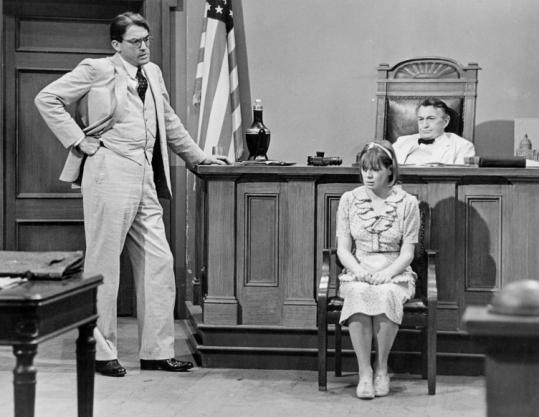
“I got somethin' to say an' then I ain't gonna say no more. That nigger
yonder took advantage of me an' if you fine fancy gentlemen don't wanta do
nothin' about it then you're all yellow stinkin' cowards, stinkin' cowards, the
lot of you.” (Lee 251) This quotation not only depicts Mayella’s frustration
towards Atticus following his numerous critical questions she was unable to
succeed in responding to, but also depicts how she believes that young,
susceptible woman like her should not be
questioned so intensely when being an “involuntary” victim to such acts of
sexual assault and intense lust. This quotation displays her interests of
wanting the “fine fancy gentleman” involved in the trail to actually take a
stand in the situation and not have Atticus doubt consistently her testimony to
the courthouse. It depicts how she believes men should be more gallant and not
let Atticus walk all over her, and that she wants the jury to not make a verdict
based on the discussion taking place where she fails to respond to Atticus’
inquiries.
According to Atticus, “She tempted a Negro. She was white, and she
tempted a Negro. She did something that in our society is unspeakable: she
kissed a black man.” (Lee 272) As result of committing this action, Mayella
felt motivated to commit perjury since she committed this crime after raising
“her hand and swore that the evidence she gave would be the truth, the whole
truth, and nothing but the truth.” (Lee 239). She has proven to be naïve, weak,
and helpless, yet also feels a sense of shame as a result of her strong desire
to fulfil her sexual desires with Tom, which motivated her to lie in court to
Judge John Taylor and to the jury. This
quotation also depicts what was socially acceptable between different races in
their community during the 1930s. Mayella values the need to be superior to
those in her surrounding, to bring joy and happiness in her private life
centered in isolation, and to seek for larger things in life. As a result of
these conceited values, she fails to value truth, dignify, and true happiness
as she sacrifices these aspects of life to fulfill her short-term desire which is
to not be found guilty at the trial.
Mayelle did not intend to cause harm to others. As a result of being in
a state of ignorance, she failed to recognize that her actions with Tom would
have escalated to extreme measures in the courthouse. It may be because that she is a member of the
Ewell family that she thought her actions were socially tolerable as she became
accustomed to how her family lives as they isolate themselves by living next to
a dump. Regardless, Mayelle has proven to readers to be a character who is
still trying to discover who she is as a person as she slowly moves from a
state of ignorance to public awareness just like Scout.
VIDEO CLIP: Atticus Cross-Examines Mayella
VIDEO CLIP: Atticus Cross-Examines Mayella
Tom Robinson
Tom Robinson is the black man accused of raping Mayella Ewell and was
defended in court by Atticus. Mr. Tate, Mr. Robert Ewell, and Mayella are the
witnesses who provide testimony’s that contradict what Tom Robinson claims to
have occurred on November 21st. Although he is accused of raping a
young woman, Tom Robinson has proven to not be ambitious, but rather immobilized.
Through Scout’s dictation of the event, readers are able to clear themselves
from the false character the Ewell’s describe Tom as being.
A lot is revealed about Tom’s character when he presents his testimony.
He stated that he truly did just want to help Mayella with the house tasks she
was incapable of completing on her own. He has proven through these acts of
compassion to be an overall sympathetic, humble and religious family man. However, as a result of the racial values that
have been established for their community to function by, the white jury
believes that Tom needs to be castigated for associating himself with Mayella
in the first place as it was not considered socially acceptable.
“The witness realized his mistake and shifted uncomfortably in the
chair. But the damage was done. Below us, nobody liked Tom Robinson’s answer.” (Lee
263) This quotation follows the moment after Tom gives his explanation of what truly
happened on November 21st. It also demonstrates Tom’s values. Tom
values human dignity, humanity, humbleness, and the need for people to be
forgiven for their immoral actions as demonstrated when he feels pity and sympathy
towards Mayella. These values are confirmed as he provides the truth of what
actually took place on November 21st, yet “nobody liked Tom
Robinson’s answer” as the white community fails to share the same values as Tom
Robinson. Tom arrives in a state of disillusionment after his goals were not fulfilled. Tom’s major goal was to
maintain hold of his human capability for goodness, but couldn’t as he was
found guilty for a crime he didn’t commit. He wanted to demonstrate to the jury
in his state of innocence that not only are the white witness’ claims false,
but also that the oppression he was bound to receive from the start was the
outcome of racial prejudice, not crime.
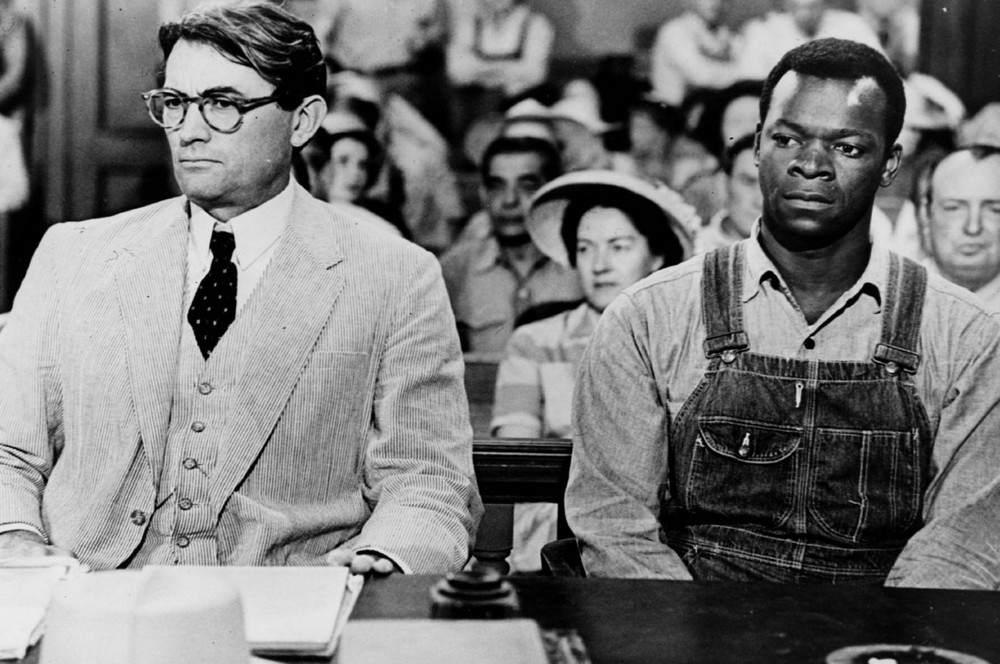 “Until
my father explained it to me later, I did not understand the subtlety of Tom's
predicament: he would not have dared strike a white woman under any
circumstances and expect to live long, so he took the first opportunity to
run—a sure sign of guilt.” (Lee 260-261) Tom was interested in getting the jury to
recognize that the untruthful accusations that have been placed on him were not
indeed true. Tom did not expect the white community to be so malicious towards
his decision to run away as they claimed it be “a sure sign of guilt”, and so
he was morally damaged as a result. Tom’s motives towards his behavior do not
appear to stream from any particular prominent figure(s), but rather from his own
interests and values. The fact that the white community thinks that he would
rape a vulnerable white woman given the opportunity to do so as he is a black man
motivates him to appear in front of the jury which is composed of white jury
members.
“Until
my father explained it to me later, I did not understand the subtlety of Tom's
predicament: he would not have dared strike a white woman under any
circumstances and expect to live long, so he took the first opportunity to
run—a sure sign of guilt.” (Lee 260-261) Tom was interested in getting the jury to
recognize that the untruthful accusations that have been placed on him were not
indeed true. Tom did not expect the white community to be so malicious towards
his decision to run away as they claimed it be “a sure sign of guilt”, and so
he was morally damaged as a result. Tom’s motives towards his behavior do not
appear to stream from any particular prominent figure(s), but rather from his own
interests and values. The fact that the white community thinks that he would
rape a vulnerable white woman given the opportunity to do so as he is a black man
motivates him to appear in front of the jury which is composed of white jury
members.
Through his testimony "It occurred to me (Scout) that in their own way, Tom Robinson's manners were as good as Atticus'" (Lee 260). This reveals how Tom is viewed as a respectful and admirable individual in Scout's eyes. “I shut my eyes. Judge Taylor was polling the jury:
‘guilty…guilty…guilty…guilty…’”. (Lee 282) This quotation on the other hand demonstrates how Tom
is an innocent individual who has lost the trial unjustly as he came into
contact with the evil that the white jurors used to make their verdict. If Tom
were to be guilty of anything, it would be the fact that he was unable to
defend himself against the racist arrogant white community of Maycomb, Alabama.
VIDEO CLIP: Tom Robinson's Trial
VIDEO CLIP: Tom Robinson's Trial

No comments:
Post a Comment